Ways to Extend the Life of a Roof
Champz Services LLC — January 2025
A commercial roof represents a significant capital investment. For most building owners, the goal is to get the maximum useful life from that investment — not to replace the roof before it is truly necessary. With the right maintenance approach, many roofing systems can remain serviceable well beyond their rated life expectancy, while roofs that are neglected often fail prematurely regardless of the quality of the original installation.
The strategies that extend roof life are not complicated. They are mostly about consistency — keeping the system clean, addressing small problems before they become large ones, and making informed decisions about when targeted repairs are appropriate versus when a restoration approach makes more sense.
Keep Drainage Systems Clear
Standing water is one of the fastest ways to shorten a roof's service life. Most roofing membranes are not designed for continuous water immersion — they rely on drainage to remove rain water within a reasonable time after a storm event. When drains and scuppers are blocked by debris, water ponds, and that ponding creates multiple problems simultaneously.
Standing water accelerates membrane degradation. It adds significant structural load to the roof deck — a large ponded area can add tens of thousands of pounds of weight to the structure. It promotes biological growth on and around the membrane. And when the drain eventually does clear, the sudden drainage and refilling cycle stresses the membrane through repeated expansion and contraction.
Clearing roof drains and scuppers at least twice per year — and after any significant storm event — is one of the simplest and highest-return maintenance actions a building owner can take. In Houston, with our heavy leaf fall in autumn and frequent storm debris, quarterly clearing is even better for most properties.
Schedule Annual or Biennial Inspections
Professional inspections catch problems while they are still small. A small open seam or a deteriorated flashing that costs a few hundred dollars to repair today becomes a major repair project — with associated interior damage — if it is left to develop for another year or two.
Inspections also provide documentation of the roof's condition over time. This historical record is valuable for capital planning, for insurance claims after storm events, and for demonstrating due diligence if a building is ever involved in litigation related to water damage.
In Houston's demanding climate, annual inspections are appropriate for roofs over ten years old or systems that have shown any prior leak activity. Newer roofs in good condition may be adequately served by biennial inspections combined with self-inspection of drains and obvious visible areas after major storm events.
Repair Flashings Promptly
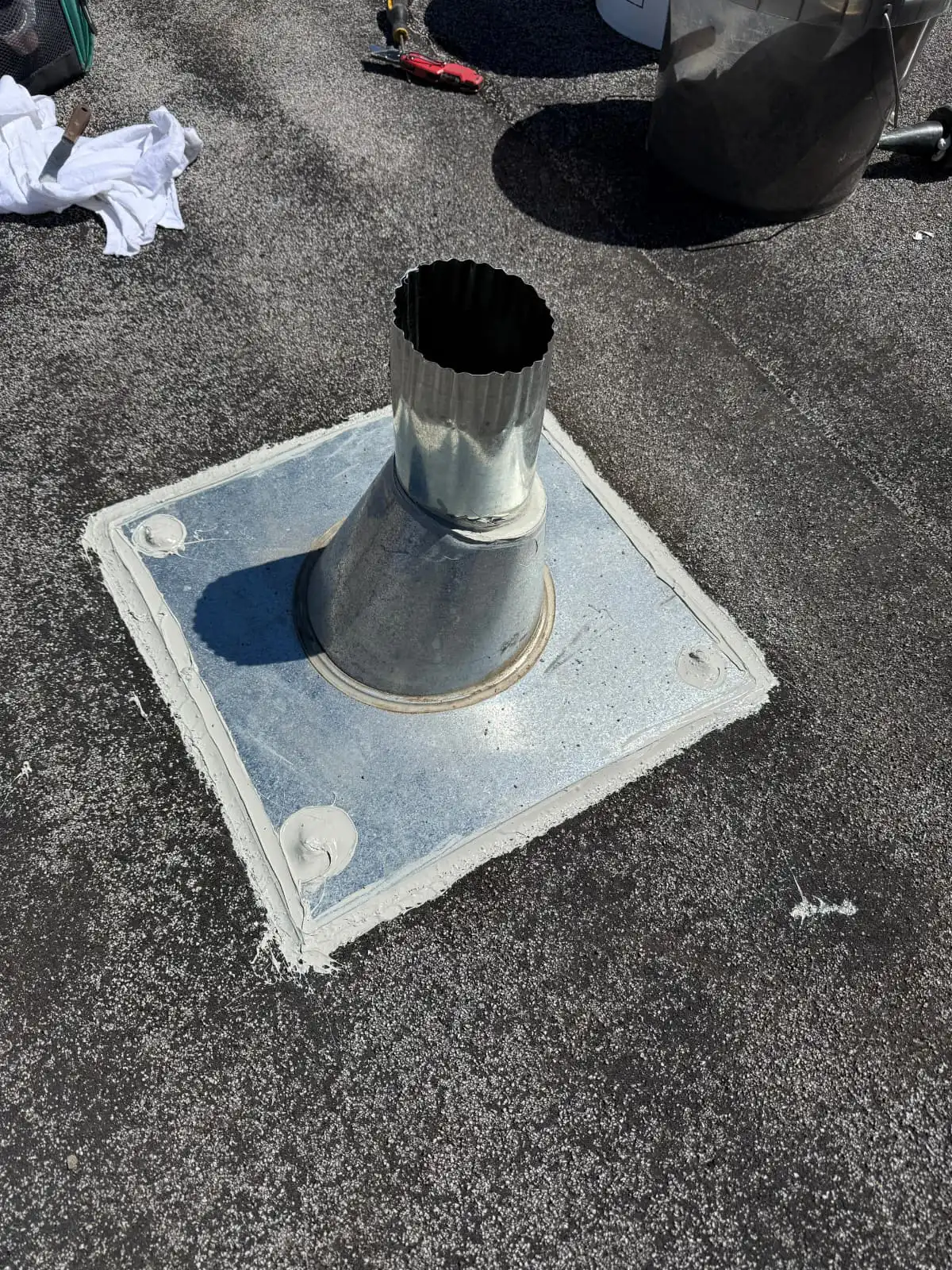
Roof flashings — the transitions at penetrations, edges, drains, and parapet walls — are the most common source of leaks and the most maintenance-intensive part of most roofing systems. They are exposed to direct weather, experience movement as the building shifts seasonally, and are often the first components to show age-related deterioration.
A deteriorated pipe penetration flashing or a separated parapet wall flashing that is repaired within one inspection cycle causes minimal damage. The same flashing left for two or three years typically allows water to penetrate the roof deck, saturate insulation, and potentially reach interior spaces — turning a simple repair into a much larger project that may involve deck replacement and interior remediation.
The rule of thumb is straightforward: when an inspection identifies a flashing problem, schedule the repair within the same season. Do not defer small flashing repairs.
Address Membrane Issues Before They Spread
Roofing membranes deteriorate in a predictable pattern. Early-stage degradation — minor blistering, surface oxidation, a small area of open seam — can typically be addressed with targeted repairs that restore the affected area to its original performance level.
If early-stage problems are deferred, they spread. A small blister becomes a large delaminated area when water infiltrates beneath the membrane. An open seam allows water to travel beneath the membrane across a wide area before surfacing. Oxidized membrane surface becomes brittle and begins to crack when it loses flexibility.
Tracking and promptly repairing any identified membrane issues keeps the roof's overall condition in the range where targeted repairs remain an effective strategy, rather than allowing it to deteriorate into the range where only a full restoration or replacement can address the overall system degradation.
Consider Restoration Before Replacement
When a flat or low-slope roof reaches the point where targeted repairs are no longer cost-effective — typically when multiple areas across the roof show systemic degradation — the choice is between restoration and replacement.
Roof restoration involves cleaning the existing membrane, completing all necessary repairs, and applying a new protective coating system over the existing surface. This approach extends roof service life by ten to fifteen years, costs significantly less than tear-off and replacement, and can be performed without evacuating the building or disrupting operations.
Restoration is appropriate when the existing membrane and deck are structurally sound, even if the membrane surface has degraded. It is not appropriate when the deck itself is compromised, when insulation is heavily saturated, or when the system has multiple structural failures rather than surface degradation.
Property owners who maintain consistent inspection and repair programs are more likely to catch roofs at the restoration window — before degradation becomes too severe. Property owners who defer maintenance often find that by the time they engage a contractor, the roof has passed the point where restoration is viable and full replacement is the only option.
Protect the Roof from Unnecessary Traffic and Damage
Commercial roofs must sometimes accommodate HVAC technicians, communications installers, and other trades who access the roof for work on mechanical or electrical systems. Each of these visits creates opportunities for accidental membrane puncture, displaced flashings, or debris left behind that blocks drains.
Establishing a controlled access policy — requiring all roof access to be logged, using walk pads on vulnerable membrane areas, and conducting a brief inspection after any significant trade activity — significantly reduces the incidence of inadvertent damage from third-party access.
The Long View
Extending the life of a roof is largely about avoiding compounding problems. Each deferred maintenance item adds complexity to the next issue that develops. Consistent attention — annual inspections, prompt repairs, clear drains, and a clear-eyed assessment of when the system needs restoration rather than repair — keeps a roofing investment performing at its full potential.
Champz Services LLC offers free roof inspections and professional repair and restoration services throughout Houston. Contact us at 346-565-0518 to discuss your property's needs.
Free Roof Inspection
Let us evaluate the current condition of your roof and recommend the right path forward.